
Level 2 · Lesson 12 · ~20 min
Speed and conviction: grind or spike
Two moves can cover the same 40 points and mean very different things. One creeps up over an hour. The other drops in five minutes. How price travels tells a seasoned trader almost as much as where it goes.
The grind: slow, overlapping candles
A grind is price moving steadily with small candles that overlap each other: each candle's range covers part of the one before. It's like walking up a long ramp. Progress is real, but nobody is in a hurry.
A grind arrives at a zone without much force behind it. That gives the zone a fair chance to show what it holds. If sellers are waiting at R1, a grind is when their wicks and closes are easiest to see.
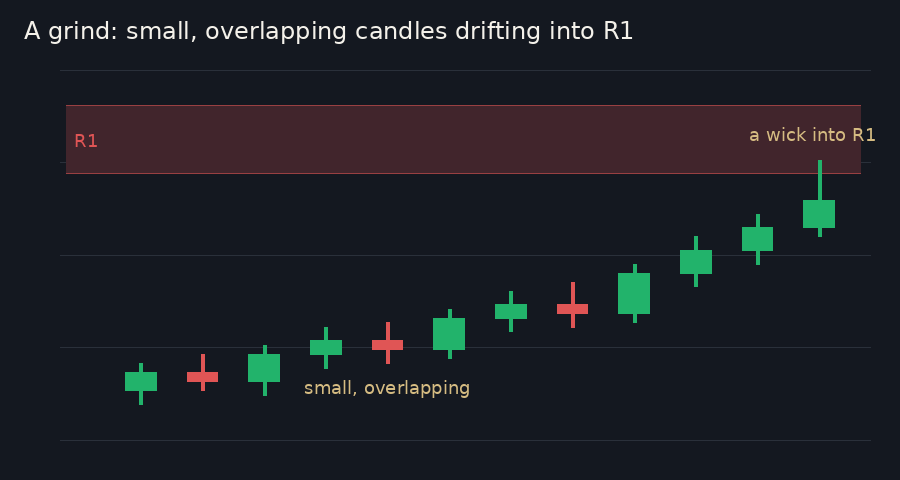
Many of the patterns in Level 3 are easiest to read when price arrives at a zone this way.
The spike: a fast vertical move
A spike is the opposite: a few large candles in a row, each closing near its extreme, covering 30 or 40 points in a few minutes. News is a common cause. Waiting orders get swept aside, and zones in the path can be crossed in a single candle.
The classroom has a name for this: an extended move. During the US session, its watcher flags a move of about 20 points in one minute, or about 35 points in five minutes. Overnight, when the market is thinner, the bar is set higher: about 30 and 40 points.
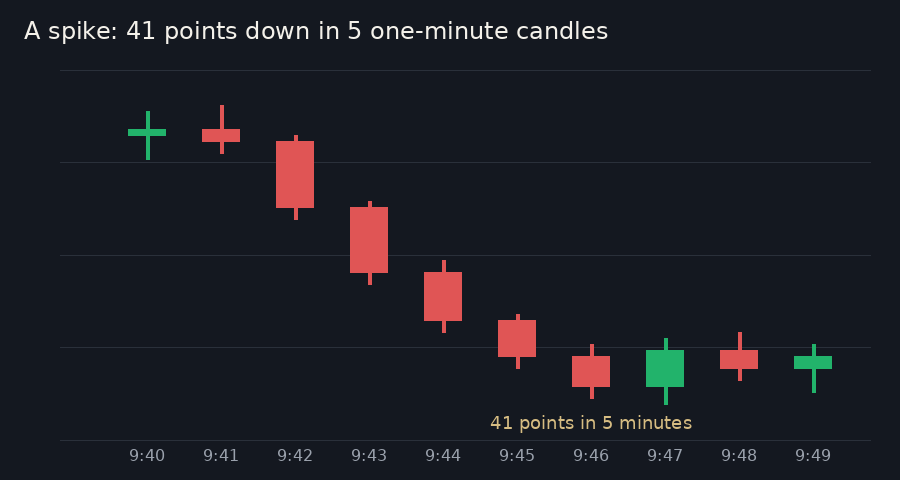
Why the classroom steps aside after a spike
After an extended move, the classroom's study plan treats the next 10 minutes as a no-new-position window. It names three things it avoids:
- Chasing: starting a position in the direction of the move after most of it has already happened.
- Fading: betting that the move will reverse.
- Adding to anything already open against the move.
Right after a spike, price is unsettled. It can snap back hard, then run again. The distances are big, so any sensible invalidation point sits a long way off. And feelings run high, which is when good habits slip.
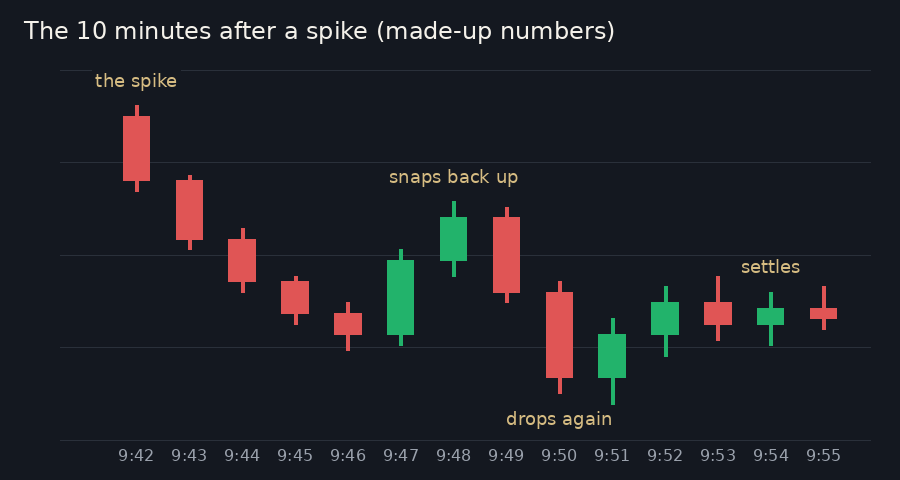
In the picture, someone who chased the spike at its low was caught by the snap back. Someone who faded it at the snap back was caught by the next drop. Ten minutes later, price had settled, and the chart was readable again.
In our posts: "📕 Lesson: extended move. NQ moved down 41 points in 5 min. In this study plan, the 10 minutes after a move like this are a no-new-position window: no chasing it, no fading it, no adding to anything open against it. Fast markets punish all three."
The post ends with an exercise: "note where price is 10 and 30 minutes from now. Would a chase have worked?" The session reflection counts how often chasing would have gone 15 or more points the wrong way first.
Conviction: closes versus wicks
Level 1 showed that a candle's body and wicks tell different stories. At a zone, that difference matters most.
A wick through a zone shows where price visited. The close shows where it settled. A candle that pokes above R1 and closes back below it is showing no conviction above R1: buyers got there, but couldn't stay. A candle that closes beyond R1, near its own high, with only a small wick, is showing conviction: buyers are staying.
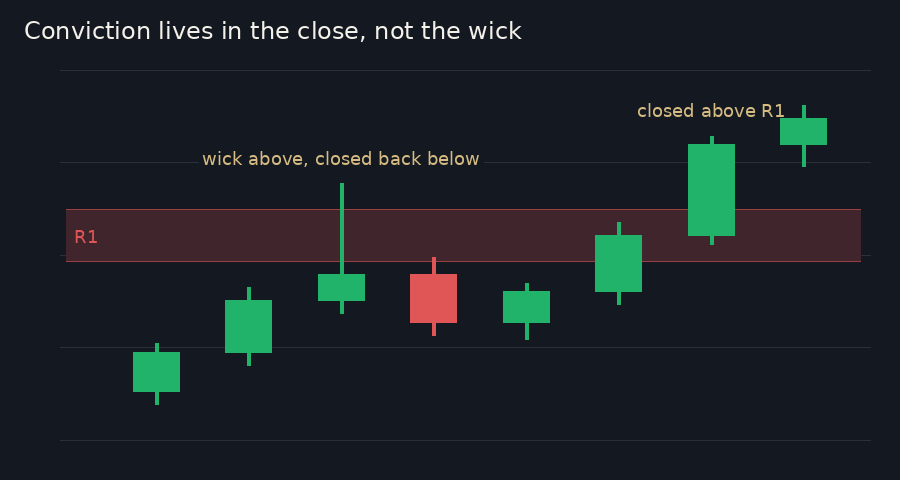
The classroom's heads-up pictures draw this difference in colour: green for the reaction a seasoned trader wants to see at a zone, red for "the close that would mean the zone is being accepted". Acceptance is decided by closes, not wicks.
Recap
- A grind is small, overlapping candles; it reaches a zone gently and gives the zone a chance to show a reaction.
- A spike is a fast vertical move; after an extended move the study plan sets a 10-minute no-new-position window: no chasing, no fading, no adding against it.
- Conviction shows in closes: a wick through a zone and a close back inside means it held; a strong close beyond it means acceptance.